
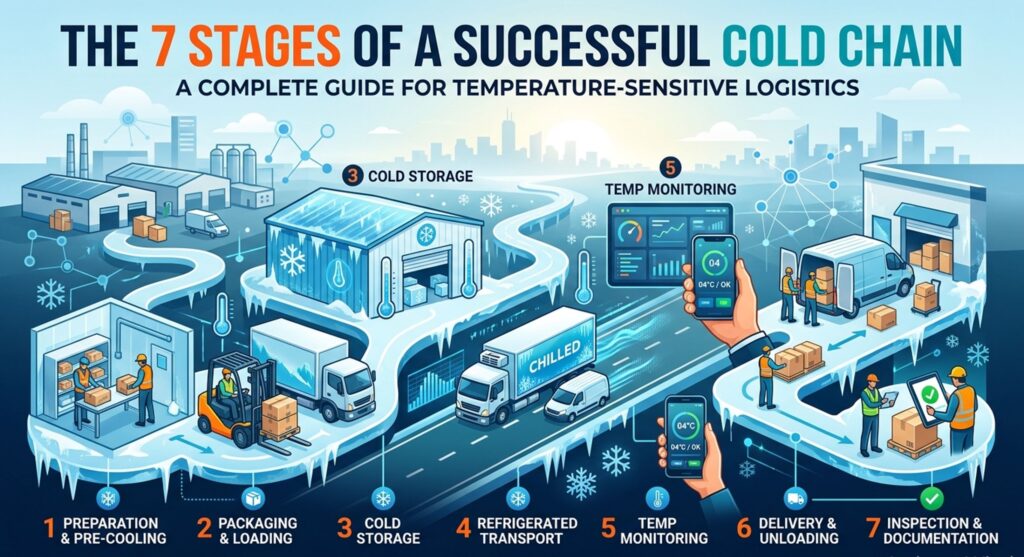
A reliable cold chain is essential for businesses transporting temperature-sensitive products such as fresh food, frozen goods, dairy products, flowers, pharmaceuticals, and other perishables.
Cold chain logistics involves much more than putting products inside a refrigerated vehicle. It is a connected process designed to keep products within their required temperature range from preparation and storage through transportation and final delivery.
For businesses operating in Dubai and across the UAE, maintaining temperature control can be particularly challenging because of high ambient temperatures. A properly planned temperature-controlled transportation system can help protect product quality, reduce avoidable spoilage, and improve delivery reliability.
In this guide, we explain the 7 stages of a successful cold chain and why each stage matters.
What Are the 7 Stages of a Successful Cold Chain?
The seven key stages are:
- Proper preparation and pre-cooling
- Correct packaging and loading
- Temperature-controlled storage
- Refrigerated transportation
- Temperature monitoring
- Delivery and unloading
- Inspection, documentation, and continuous improvement
Every stage contributes to maintaining product quality and temperature control.
1. Proper Preparation and Pre-Cooling
The cold chain begins before products are loaded into a refrigerated vehicle.
Temperature-sensitive products should be prepared according to their required storage conditions. Where appropriate, products should already be at the correct temperature before transportation begins.
A refrigerated vehicle is generally intended to maintain the required temperature, rather than rapidly cool large quantities of warm products.
The vehicle should also be prepared before loading. The refrigeration system should be operating correctly, the cargo area should be clean, and the required temperature should be established before products are loaded.
Proper preparation helps reduce unnecessary temperature fluctuations during transportation.
2. Correct Packaging and Loading
Packaging plays an important role in protecting temperature-sensitive products.
Products should be packaged appropriately to help maintain their required conditions while also protecting them from physical damage. Loading is equally important because incorrectly positioned goods can interfere with airflow.
Businesses should avoid blocking air circulation around the refrigeration equipment and should distribute the load appropriately throughout the cargo area.
The vehicle should also have sufficient capacity for the quantity and weight of products being transported.
For businesses that need flexible temperature-controlled vehicles, Freightline’s chiller van rental service in Dubai provides refrigerated vehicle options for temperature-sensitive deliveries.
Proper loading can help the refrigeration system maintain more consistent conditions throughout the cargo area.
3. Temperature-Controlled Storage
After preparation, products may need to remain in refrigerated or frozen storage before transportation.
The storage environment should match the requirements of the products. Different goods can require different temperature ranges, so businesses should establish the appropriate conditions before storage and transportation.
Temperature mapping is an important part of understanding how temperatures are distributed within cold rooms, freezers, refrigerators, and other temperature-controlled spaces.
The World Health Organization explains that temperature mapping involves recording temperatures across a three-dimensional space to understand temperature distribution and identify potential variations.
For businesses handling highly temperature-sensitive products, monitoring storage conditions can help identify potential problems before products leave the facility.
4. Refrigerated Transportation
Refrigerated transportation is one of the most important stages of the cold chain.
A suitable refrigerated vehicle should be selected based on:
- Product type
- Required temperature
- Load size
- Product weight
- Delivery distance
- Number of deliveries
- Loading and unloading requirements
Chiller vehicles are suitable for products requiring controlled chilled conditions, while freezer vehicles are designed for products requiring significantly lower temperatures.
Freightline Refrigerated Transport provides refrigerated transportation in Dubai and across the UAE using chiller and freezer vehicles for temperature-sensitive goods. The company states that its fleet includes 1–3 ton chiller and freezer vans and serves industries including food, dairy, poultry, flowers, pharmaceuticals, and general goods.
During transportation, unnecessary door openings should also be minimized because opening the cargo compartment allows warmer outside air to enter.
This is particularly important in Dubai’s hot climate, where external temperatures can place additional demands on refrigerated transportation systems.
5. Temperature Monitoring
A successful cold chain depends on more than simply having a refrigeration unit operating.
Businesses should know whether the required temperature is actually being maintained throughout storage and transportation.
Depending on the products and operational requirements, temperature monitoring may involve:
- Thermometers
- Temperature data loggers
- Digital temperature monitoring systems
- Temperature alarms
- Temperature mapping
The WHO identifies temperature monitoring and mapping as important tools for understanding temperature conditions within cold-chain environments. Its guidance also discusses monitoring refrigerated vehicles and identifying temperature variations within transport equipment.
Monitoring can also help businesses investigate temperature excursions.
If a problem occurs, temperature records can help determine when and where the temperature moved outside the required range, allowing businesses to investigate and take corrective action.
6. Delivery and Unloading
The cold chain does not end when the vehicle reaches its destination.
Products should be unloaded efficiently and transferred into the appropriate storage environment as quickly as practical.
Extended exposure to outdoor temperatures can affect temperature-sensitive products, especially during hot weather.
Delivery teams should also handle products carefully to prevent physical damage.
For food businesses, proper unloading can help preserve freshness and product quality. For pharmaceuticals and other highly temperature-sensitive products, businesses must follow the applicable product-specific storage and handling requirements.
Efficient delivery planning is therefore just as important as transportation itself.
Businesses requiring frozen transportation can also explore Freightline’s freezer van rental service in Dubai for temperature-controlled deliveries.
7. Inspection, Documentation and Continuous Improvement
The final stage of a successful cold chain is reviewing what happened throughout the process.
Businesses should inspect deliveries, verify quantities, check product condition, and maintain appropriate temperature records where required.
If a problem occurs, such as:
- Temperature excursions
- Damaged packaging
- Delayed deliveries
- Incorrect quantities
- Product quality issues
the issue should be investigated.
Documentation allows businesses to identify recurring problems and improve their cold-chain procedures.
For larger operations, ongoing monitoring can reveal weaknesses in storage, loading, transportation, or delivery.
The WHO’s cold-chain resources emphasize temperature monitoring, mapping, documentation, and identifying weaknesses as part of improving temperature-controlled supply chains.
Why All 7 Stages Matter
A cold chain is only as strong as its weakest stage.
Proper storage cannot compensate for poor transportation, and an excellent refrigerated vehicle cannot fix incorrect preparation or loading.
The complete process can be summarized as:
Preparation → Packaging & Loading → Storage → Refrigerated Transportation → Temperature Monitoring → Delivery → Inspection & Improvement
When these stages work together, businesses can better protect temperature-sensitive products, reduce avoidable spoilage, maintain product quality, and create a more reliable delivery operation.
Cold Chain Challenges in Dubai
Dubai’s climate makes temperature control particularly important for businesses transporting perishable goods.
High outdoor temperatures can increase the difference between ambient conditions and the required cargo temperature.
Businesses should therefore consider:
- Selecting the correct refrigerated vehicle
- Preparing vehicles before loading
- Minimizing unnecessary door openings
- Loading products correctly
- Monitoring temperature conditions
- Planning delivery routes efficiently
- Reducing unnecessary delays during unloading
Choosing the right vehicle is particularly important. Freightline offers chiller vans and freezer trucks for rental in Dubai with flexible rental options for businesses requiring temperature-controlled transportation.
Choose Reliable Refrigerated Transportation in Dubai
Restaurants, catering companies, food distributors, supermarkets, pharmaceutical businesses, florists, and other organizations handling temperature-sensitive products need dependable refrigerated transportation.
Freightline Refrigerated Transport provides chiller van rental, freezer van rental, and temperature-controlled transportation solutions for businesses in Dubai and across the UAE.
Choosing the right refrigerated vehicle and transportation service can help businesses maintain temperature control from pickup to final delivery.
Explore Freightline’s refrigerated transportation services to find a solution for your business requirements.
Frequently Asked Questions
What are the 7 stages of a successful cold chain?
The seven stages are preparation and pre-cooling, packaging and loading, temperature-controlled storage, refrigerated transportation, temperature monitoring, delivery and unloading, and inspection, documentation, and continuous improvement.
Why is temperature monitoring important in cold chain logistics?
Temperature monitoring helps businesses determine whether products are remaining within their required temperature range. It can also help identify and investigate temperature excursions.
Why is pre-cooling important?
Pre-cooling helps ensure products are already at their required temperature before transportation. Refrigerated vehicles are generally designed to maintain product temperature rather than rapidly cool large quantities of warm products.
What is the difference between a chiller van and a freezer van?
A chiller van is designed for chilled products requiring controlled temperatures, while a freezer van is intended for products requiring substantially colder conditions. The appropriate vehicle depends on the product’s specific temperature requirements.
Why is refrigerated transportation important in Dubai?
Dubai’s high ambient temperatures can make temperature control more challenging. Reliable refrigerated transportation helps businesses move temperature-sensitive goods while maintaining the conditions required for the products.
Conclusion
A successful cold chain is a connected system rather than a single transportation step.
From preparation and packaging to storage, refrigerated transportation, temperature monitoring, delivery, and final inspection, every stage plays an important role.
For businesses in Dubai and across the UAE, selecting suitable refrigerated transportation is an important part of maintaining this chain.
With the right procedures, monitoring, vehicle, and delivery planning, businesses can better protect temperature-sensitive products and provide more reliable service to their customers.
If you need chiller van rental, freezer van rental, or refrigerated transportation in Dubai, contact Freightline Refrigerated Transport to discuss your requirements.